
 Televison New
When people try to explain why Heartland has accumulated 695 million hours of global Netflix viewing in just two years — making it one of the platform’s most-watched catalog titles while carrying a TV-PG rating, no prestige drama credentials, and almost no marketing budget outside Canada — the answers usually focus on horses, or nostalgia, or the scenery. Those answers are not wrong. But they are not complete. The fuller explanation sits in a piece of data from a March 2026 industry study published by The Wrap: conservative, rural, and middle-American viewers have consistently reported feeling underrepresented in the movies and TV shows produced by major studios — and Heartland has been quietly, steadily serving that audience for nineteen years while almost everyone in Hollywood looked the other way.
The Audience Nobody In Hollywood Talked About
For most of the past decade, the conventional wisdom in prestige television was fairly simple: edgy content, morally complex characters, and adult themes drove critical acclaim and subscriber growth. Shows like Breaking Bad, Succession, and Game of Thrones defined what “good television” was supposed to look like, and the audiences that preferred something quieter, cleaner, and more family-oriented were treated as a niche — a legacy broadcast demographic slowly aging out of cultural relevance.
The data was always telling a different story. According to the NRG study cited by The Wrap in March 2026, studios had been overlooking a measurable and economically significant segment of the American audience: conservative, rural, and middle-American viewers who felt mainstream entertainment did not reflect their values or their lives. The study found that in 2025, studios began reassessing their relationship with audiences who do not live in Los Angeles, New York, or other cosmopolitan cultural hubs, and increased their investment into stories that speak more directly to audiences who had previously regarded mainstream entertainment with a fair degree of skepticism. The result, the study noted, was a small but noticeable uptick in the percentage of conservative viewers who felt their values and beliefs were being represented on screen.
That shift in 2025 was not a discovery. It was a belated acknowledgment of something Heartland had known since 2007.
What “Faith-Based” Actually Means in Heartland’s Context
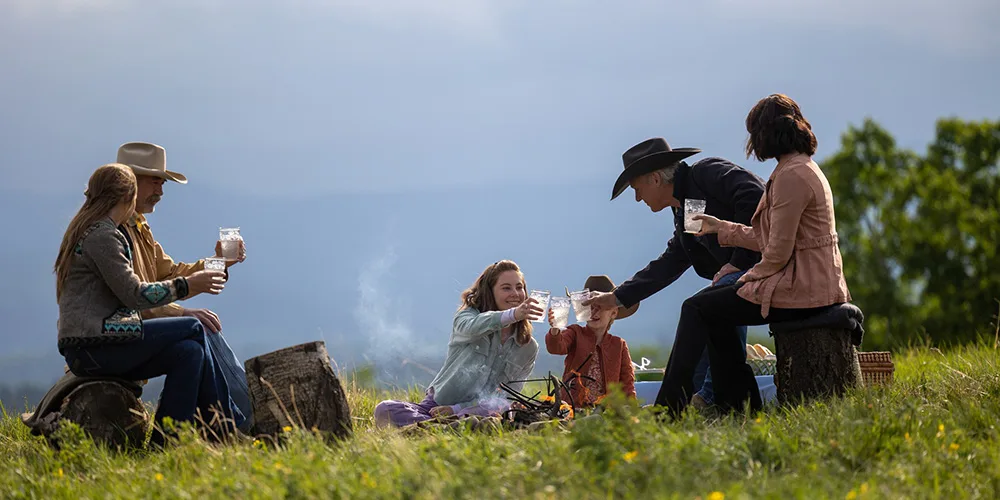
Heartland is not, technically, a Christian show. It is not produced or marketed as religious entertainment, and its storylines do not center on doctrinal content or overt evangelism. Its characters occasionally attend church, occasionally pray at meals, and occasionally navigate the kind of moral questions — loyalty, forgiveness, integrity under pressure — that religious frameworks have traditionally provided language for. But the show’s faith content is incidental rather than central, woven into the fabric of characters who happen to hold those values rather than characters defined by them.
What the show does embody, consistently and deliberately, is a set of values that overlap significantly with faith-based priorities without being reducible to any specific religion: multigenerational family loyalty, honest labor, community accountability, the idea that the land and the people who work it carry a dignity that deserves respect. These are not explicitly Christian values — they are rural values, and the two categories overlap without being identical.
Charley Humbard, founder of UP Entertainment, the network that holds first-window U.S. streaming rights to Heartland, has spoken about this distinction directly. “It executes on a lot of good basic Christian and family values so well and it’s real and authentic,” he told The Christian Post. But he was equally clear that the show’s appeal extends beyond any single religious demographic. “Just because you’re a Christian doesn’t mean you don’t have a kid that sometimes ends up with a drug addiction, or a teenager who gets pregnant before they should, or tough times happen to you,” he explained. “Things happen. Just because you’re Christian doesn’t mean it won’t.” That authenticity — the show’s willingness to portray real difficulty inside a framework that still believes in resolution and family — is precisely what distinguishes it from content that moralizes rather than narrates.
UP Entertainment’s own research suggested at the time that over 40 million Americans were actively seeking wholesome, family-safe content on television. Heartland was its flagship vehicle for reaching them.

The Companies That Understood First — and the Returns They Generated
The faith-and-family audience that Heartland had been quietly serving did not stay invisible forever. As the NRG study noted, studios and streaming services began taking notice in 2025, following a string of high-profile financial results from content that targeted this demographic explicitly.
Angel Studios, the company behind The Chosen and Sound of Freedom, went public in September 2025 following the success of its crowd-funded model, becoming one of the more unusual success stories in recent entertainment industry history. Its model — asking audiences to fund content they actually want rather than predicting what audiences might accept — generated enough revenue to sustain an independent studio and attract mainstream distribution attention. In October 2025, Prime Video launched Wonder Project, a premium subscription add-on specifically for faith-based content, with the platform-exclusive series House of David as its headline title. That these moves happened in 2025, not 2015, is a measure of how long the industry underestimated the audience size.
The NRG study also turned up a finding that challenges some of the assumptions behind faith-based content’s perceived demographic limitations: Millennial and Gen Z Christians are actually more likely to seek out content with religious themes than older generations. If accurate, this suggests the faith-and-family audience is not an aging demographic in terminal decline but a cross-generational viewership that has simply not been well-served by mainstream production pipelines — and is now beginning to be.
Why Heartland’s Numbers Carry a Specific Warning for Hollywood
The 695 million global viewing hours that Heartland generated on Netflix between 2023 and mid-2025 are notable not just for their scale but for what they reveal about the show’s audience behavior. Unlike prestige dramas that generate large numbers in a concentrated burst around premiere weekends, Heartland‘s viewing is distributed differently — spread across a back catalog of over 260 episodes, accumulated by viewers who return to the same seasons repeatedly rather than burning through new content and moving on. This repeat-viewing pattern is structurally more valuable to a streaming platform than a single spike, because it keeps subscribers on the platform between new releases.
That behavioral pattern is characteristic of the faith-and-family audience more broadly. Viewers in this demographic tend to watch more slowly, more deliberately, and with more household participation — multiple family members watching together rather than individuals consuming content on separate devices. Those viewing habits drive hours-watched metrics far higher than solo streaming behavior would, which partly explains how a TV-PG Canadian ranch drama can post numbers that rival or exceed prestige productions with ten times the marketing investment.
What Hollywood is slowly learning, and what Heartland demonstrated years before the industry was paying attention, is that underrepresented audiences do not disappear when you ignore them. They find what serves them and they stay loyal to it in ways that more casual audiences rarely match. The 695 million hours are not the result of a viral moment or a prestige campaign. They are the result of nineteen years of consistent, authentic storytelling aimed at an audience that had very few other options — and chose to stay.
As Season 20 films in Alberta this summer, Heartland is preparing to close whatever chapter it is closing with that same audience still watching. Whether Hollywood has fully absorbed the lesson the show spent two decades teaching is, at this point, a separate question entirely.