
 Televison New
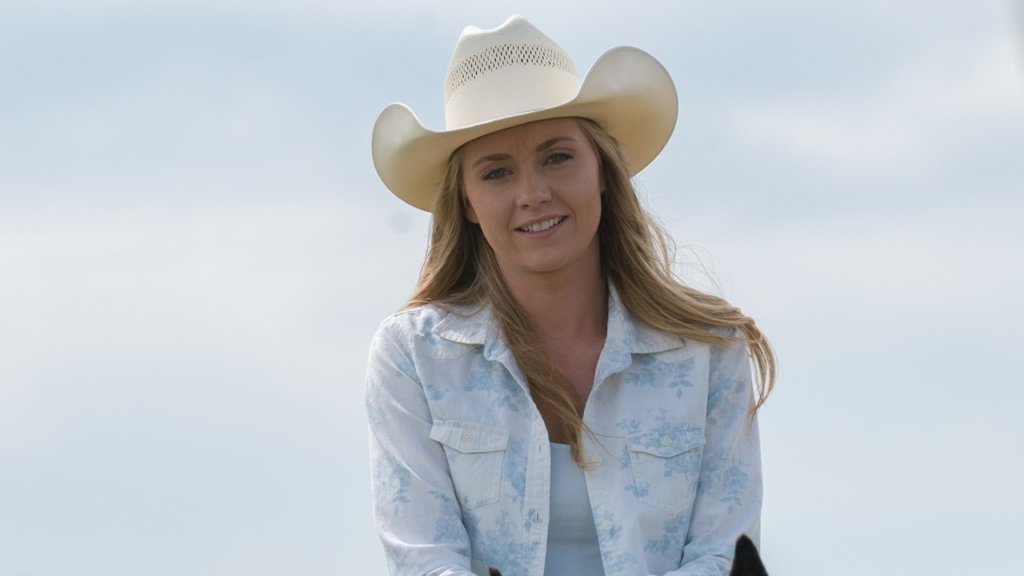
There is a particular kind of celebrity that comes from spending two decades playing a beloved character in a beloved show, and it tends to produce one of two things: an actor who cannot separate themselves from the role, or an actor who quietly builds a life so full and genuine that the role becomes just one part of a much larger story. Amber Marshall, who has played Amy Fleming on Heartland since 2007, belongs firmly in the second category. Ask her about fame, and she will redirect the conversation to her horses. Ask her about legacy, and she will tell you about the families who write to say they watch the show together. Ask her about happiness, and she will tell you something so simple it almost sounds like a deflection until you realize she actually means it: “I want to show people that you can be content just being who you are.” That sentence — six words of philosophy inside an interview answer — is as close to a mission statement as Marshall has ever offered. And over nineteen seasons on one of television’s most quietly influential shows, she has earned the right to mean every word of it.
The Dream That Had to Wait
Marshall was born on June 2, 1988, in London, Ontario — and she knew what she wanted almost immediately. She began riding at the age of three, was circling ranch property listings in real estate magazines by the time she was ten, and had her heart set on a life that combined animals with performance from before she had the vocabulary to describe what that combination might look like professionally.
She waited a long time for it. Her early career consisted of television commercials and small guest roles — appearances in Twice in a Lifetime, Doc, Monk, Dark Oracle, and a TV movie about Elizabeth Smart — the kind of résumé that sustains hope without yet confirming it. The Heartland pilot came in 2007, when she was eighteen years old. “It wasn’t until I was 18 that I got Heartland,” she told an interviewer with a smile that suggested she had made peace with the timeline. “So I had to wait a little while before that dream came true.”
That patience — the willingness to wait for the right thing rather than grab the nearest available version of it — is a quality that runs through everything Marshall has said publicly about her career and her life. She did not move to Los Angeles to chase visibility. She moved to Alberta when the show brought her there, found that it felt right, and stayed. She has filmed in the same geographic area for nearly twenty years. She calls that a feature, not a limitation.
On Animals: The Philosophy That Predates the Career
Long before Heartland, before Amy Fleming, before any of it, Amber Marshall had a horse named Tony the Pony who started everything. The relationship between Marshall and animals is not a persona she adopted for the show and maintained afterward — it is the foundation on which everything else was built, including the show.
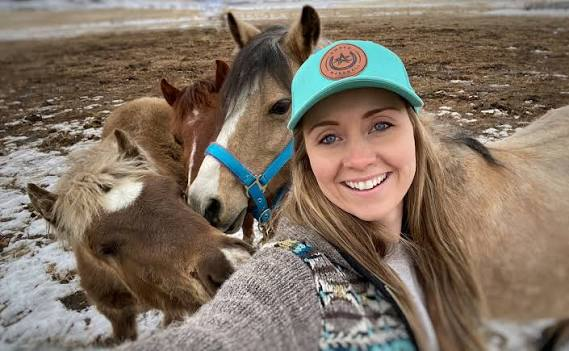
Her most quoted statement on the subject captures something specific about why animals matter to her in a way that goes beyond simple affection: “Animals keep me grounded. They don’t care who you are or what you look like — they just say, ‘All right, let’s go do this.'” That last phrase — all right, let’s go do this — is not poetic language. It is the language of someone who genuinely prefers the company of creatures that make no distinctions between who you are on television and who you are in a barn at six in the morning. Animals are, in her framing, the original antidote to ego.
During breaks between filming seasons, Marshall volunteers at veterinary clinics and a Wildlife Rehabilitation Centre, where she has participated in raptor classes to gain experience working with falcons and hawks. These are not scheduled appearances or charity photo opportunities — they are activities she pursues specifically to expand her knowledge of animals beyond what the show requires of her, in settings where her name means nothing and her competence with the animal in front of her is the only thing that matters. That choice, repeated quietly across two decades, says more about her actual values than any interview answer could.
“Any chance I get, I’m spending it with my animals,” she told Cowgirl Magazine in January 2026. “They make me happy. They’re what keep me balanced.”
On the Show’s Legacy: Lives Touched, Not Awards Won
Marshall won the inaugural Canada’s Screen Star Award at the first Canadian Screen Awards — a recognition from the industry that her work had been seen and valued. She has not made much of that award in subsequent years. What she talks about instead, consistently and across many different interviews, is the mail.
“I live my life for me,” she told MovieGuide in 2026, “but I also think about the hundreds, thousands of lives I’ve touched through the show, interviews, whatever it might be. I hear from families who say, thank you for creating something wholesome we can watch together. That means a lot.”
That framing — not awards, not viewership numbers, not streaming charts, but the specific experience of families watching something together — reveals what she actually thinks the show is for. Not content delivery. Not brand building. Not prestige. Something closer to what she described in another interview as the quiet power of horses and open spaces to bring people together: a feeling that cannot be manufactured or monetized, only maintained, season after season, by people who actually believe in what they are making.
Her articulation of why Heartland has lasted nineteen seasons — and why she believes it could last more — always comes back to this same ground. “I believe horses have a lot to do with the longevity of Heartland,” she says. “You can feel their power even through a screen.” It is a statement that would sound like marketing language from almost anyone else, but from Marshall, who works with her own horse Hawk on set every day, goes home to her farm in Alberta every night, and spends her off-seasons at veterinary clinics by choice, it reads as observation rather than pitch.
On Fame: Why She Never Chased It
The most striking thing about Amber Marshall’s public persona, observed across nearly two decades of interviews, is how completely it fails to perform celebrity. There is no aspiration toward a larger platform, no pivot toward film or American television, no calculated brand evolution. Her clothing store in Diamond Valley sells western wear made by local Alberta artisans. Her farm outside Calgary is where she actually lives. Her social media reflects the same life she describes in interviews. The consistency between what she says and how she lives is so complete that it has become, almost paradoxically, one of the most distinctive things about her in an entertainment industry built on aspiration and reinvention.
She went skydiving last season with her husband Shawn and a few Heartland castmates, and her description of the experience is characteristic: “It was peaceful. You can’t really describe it until you’ve done it. We were free-falling for almost a minute, then just gliding for eight minutes, looking around at everything. It was for us. We loved it.” She is not describing a content moment. She is describing a private experience she is willing to share because it was genuine, not because it was photogenic.
Her philosophy of contentment — “I want to show people that you can be content just being who you are. Laugh at yourself. Do crazy things. Live for you, not anyone else. Do it because it feels right and makes you happy” — is not the language of someone managing a public image. It is the language of someone who made a specific kind of peace with herself early enough that she never needed to manage one.
On the Character She Has Become
Perhaps the most revealing thing Marshall has said about the relationship between herself and Amy Fleming is also the simplest: “I think that over time, my character has become more like me, and I have become more like my character.” That mutual influence, tracked across nineteen seasons of scripts and improvisations and genuine relationships with animals on a genuine ranch, is what makes the show’s authenticity feel earned rather than performed. Amy Fleming heals horses by paying attention and staying calm. Amber Marshall volunteers with raptors on her days off. One of those things is fictional. The other is not. The gap between them is narrower than it has any right to be.
“My life has kind of been on repeat for twenty years,” she said in a January 2026 interview. “Filming through summer, traveling through fall, family time at Christmas, then back on the road until spring.” She said it not as a complaint but as a description — of a life that has found its rhythm and kept it, which is a rarer kind of success than most people in the entertainment industry are willing to admit they actually want.
As Season 20 films in Alberta this summer, Marshall has said she hopes the show can continue for “another decade or more.” Whether that happens depends on decisions above her. But what she has already built — the career, the farm, the store, the philosophy, the two decades of families watching together — does not depend on any of that. It is already there.